
Commercial, Industrial, & Residential
SEPTIC TANK & CESS POOL
TREATMENT
Removes grease from lines. Bio-S.E.P. with Shurzyme -- the
modern way to keep your septic tank or cess pool clean and sanitary.
SEPTIC TANKS & CESS POOLS
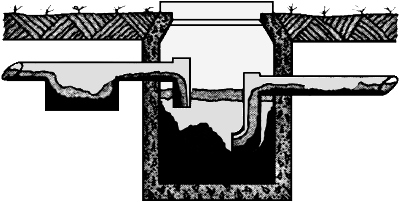
If your septic tank isn't functioning properly, it probably looks like the
diagram below. Solids and grease begin to clog the drainage pipes, as well
as the tank and the leach field.
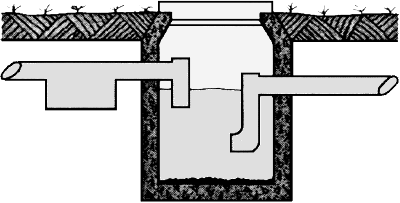
Bio-S.E.P. with Shurzyme Microbes actually breaks down the solids and
eliminates grease. Creating a clean and efficient tank like the diagram
below. Bio-S.E.P. also treats the leach field, making it work correctly.
The best thing is, Bio-S.E.P. is environmentally friendly, and will help
the surrounding area.
Problem:
Septic tanks contain bacteria which digest organic waste. Although there
are billions of bacteria in the average septic tank, many septic tanks are
out of balance because they do not have enough grease-digesting and soap-digesting
bacteria. In some cases, organic solids are only partially digested. In
other instances, grease that accumulates over a long period coats and blocks
the inside of the septic tank. When an out-of-balance septic tank is not
maintained properly, sewage will back up, commodes will become clogged,
and the tank will require frequent pumping.
Solution: Bio-S.E.P.with Shurzyme
- Provides bacteria to digest organic waste.
- Is harmless to humans, animals, and plumbing.
- Helps nature by restoring a natural balance to septic tank systems.
- Treats the cause of the problem, not just the effect. Does not kill
existing bacteria as caustics and acids do.
- Eliminates odors by digesting solid particles so they can be carried
away as liquids.
- Keeps pores open, to carry away the liquid outflow from the tank into
the tile field.
The Use of Bio-S.E.P. with Shurzyme in Clogged Septic Tank Leach Fields
In all septic tank treatment the soil is an integral part of the treatment
facility. The tank itself accomplishes two purposes.
- It allows solids to settle.
- It provides a means to liquefy the settled solids.
It is in the soil that an extremely high BOD liquor is degraded by aerobic
microbe to the level that allows safe contact with ground water. The aerobic
soil organisms produce substances that kill the enteric microorganisms which
may be a source of disease.
All this is accomplished in a well-operating leach field. Unfortunately,
the treatment process begins to break down as soon as the leach field becomes
overloaded either by excess hydraulic flow of excess organic loading.
When either too much water or too many nutrients reach the soil, the soil
begins to become anaerobic. That is, the aerobic organisms that accomplish
waste degradation are replaced by anaerobic organisms. Under anaerobic conditions
the excess nutrients in the field are not degraded as efficiently as under
aerobic, and the enteric organisms are not inactivated. In order to do this,
the addition of nutrients must be stopped temporarily. The addition of specific
microbes to degrade the excess nutrients will speed the process and minimize
the shutdown time.
The build-up of sludge and odor in septic tanks is reduced by bacterial
cultures and their enzymes. Significant benefits occur in the soil surrounding
the field lines as well. The leach field is seldom properly constructed
and is commonly biologically overloaded. Effluent pools because of sagging
lines, making the soil anaerobic and precipitating iron sulfide from soil
water. This reduces the capacity of the soil to take water, and an entire
leach field may eventually become plugged. The leach field must then be
either relocated or dug up and relaid in the same place. Both procedures
are extremely expensive.Bacterial cultures deconcentrate the effluent liquid.
With lowered demand on the soil, pIugging becomes much less likely. Bacterial
cultures may also be used to clear a clogged field. If the field is still
accepting effluent, the microbes may be applied through the distribution
box. If not, treatment is still possible by taking the field temporarily
out of service.
SEWAGE TREATMENT
The Activated Sludge Process
This process applies to residential, commercial, and industrial sewage treatment.
The purpose of sewage treatment is to change the organic carbon and hydrogen
in the waste to inorganic compounds: carbon dioxide and water. The process
is called mineralization and, as can be seen, involves the combination of
organic carbon compounds with oxygen.
In ecological terminology, bacteria are given the position of mineralizers.
Thus, bacteria are ideally suited for the job they have to do in sewage.
The activated sludge process is the most common sewage treatment process
used in the United States today. It is an anaerobic process (dissolved oxygen
is present at all times), and involves inoculating the incoming sewage with
the settled biosolids (sludge) from the processed sewage which has just
left the plant.
The idea behind this inoculation is to put an actively metabolizing colony
of organisms into the incoming sewage to initiate the breakdown process.
In general, this process works very well. However, since it is dynamic (i.e.
sewage is always flowing in; sludge is always settling; treated sewage is
always flowing out) it is susceptible to small changes at one point making
large changes at another. Theoretically, the heterotrophic organisms (those
that use organic carbon as a food source versus autotrophic organisms which
use carbon dioxide as the source of food) ordinarily present in sewage should
be able to degrade all the organic compounds in the sewage. However, it
turns out that these heterotrophs form polymers as they grow, and some of
the polymers are positively detrimental to the activated sludge process.
The polymers affect the process by increasing the water holding ability
of the solids. Water retention both increases the sludge volume and decreases
the settling rate, so that treatment plants often do not work efficiently
at their design specifications.
